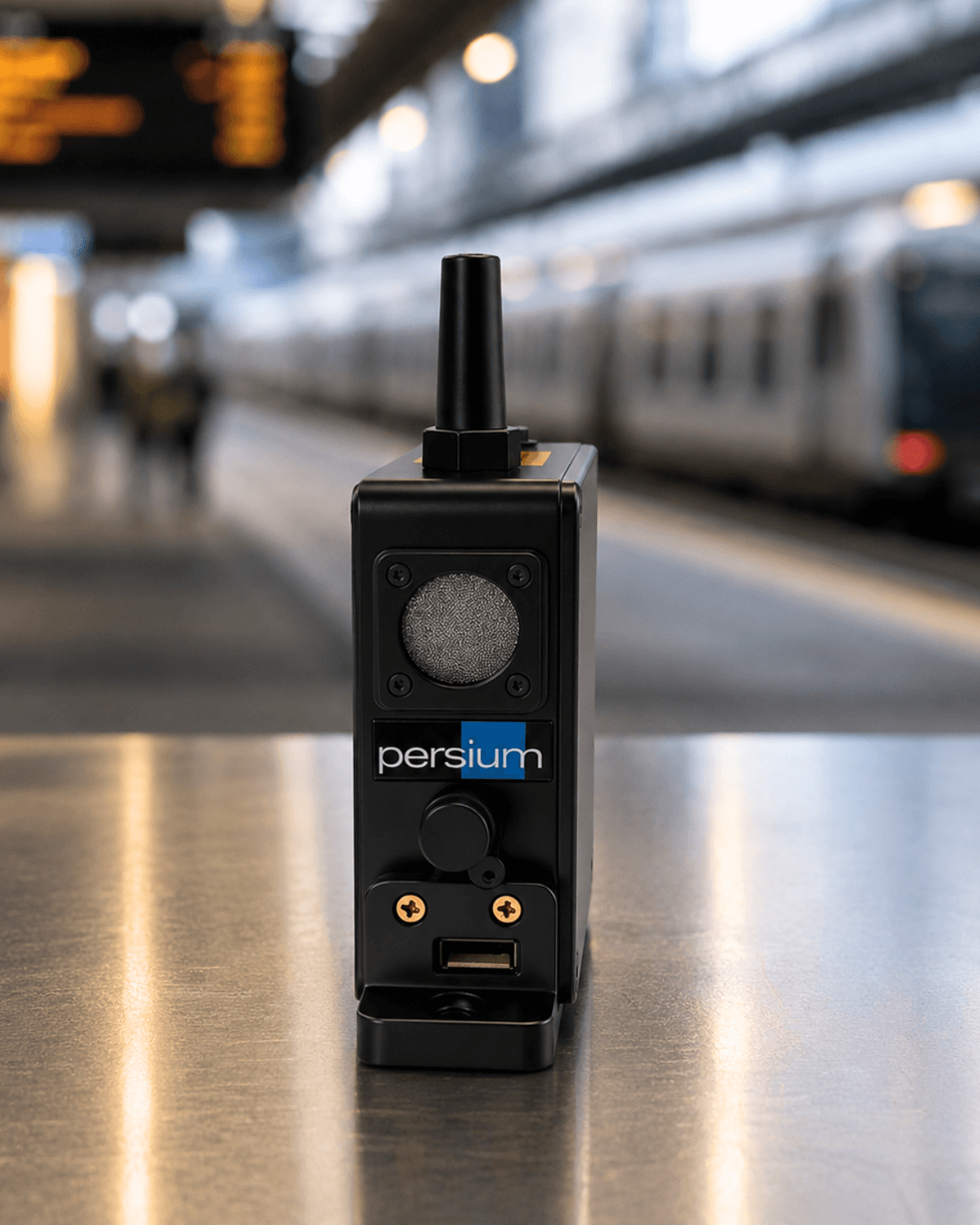
Designed for continuous outdoor deployment across real-world environments.
Glossary & Index
Knowledge Hub
Air Quality Glossary & Pollutant Index
A complete reference guide to air quality terms, pollutants, and health standards, from PM2.5 and NOx to WBGT and AQI, explained in plain English.
Pollutant Index
Every pollutant Persium monitors, what it is, where it comes from, its health effects, and the WHO guideline values where applicable.
Nitrogen Dioxide (NO₂)
What it is: A reddish-brown gas produced by the burning of fossil fuels — particularly in vehicle engines and industrial processes.
Sources: Road traffic, power stations, heating systems, and industrial combustion.
Health effects: Irritates the respiratory tract. Long-term exposure is linked to asthma, reduced lung function, and increased risk of respiratory infections.
WHO guideline: 10 µg/m³ annual mean; 25 µg/m³ 24-hour mean (WHO 2021)
Measured by: Measured by the Persium Pod and Pill
Nitric Oxide (NO)
What it is: A colourless gas and precursor to NO₂, formed during high-temperature combustion. Reacts rapidly with oxygen and ozone in the atmosphere.
Sources: Vehicle exhaust, power generation, and industrial emissions.
Health effects: At high concentrations, can cause respiratory irritation. Contributes to the formation of NO₂ and ground-level ozone, both significant health risks.
WHO guideline: No specific WHO guideline — monitored as part of NOx alongside NO₂
Measured by: Measured by the Persium Pod and Pill
Ozone (O₃)
What it is: A gas found both in the upper atmosphere (where it protects from UV) and at ground level, where it forms as a secondary pollutant through reactions between NOx and VOCs in sunlight.
Sources: Not emitted directly — formed from vehicle exhaust and industrial emissions reacting in sunlight.
Health effects: Irritates eyes, nose, and throat. High concentrations damage lung tissue. Particularly harmful to people with asthma and cardiovascular disease.
WHO guideline: 60 µg/m³ peak season daily 8-hour mean (WHO 2021)
Measured by: Measured by the Persium Pod and Pill
Sulphur Dioxide (SO₂)
What it is: A colourless gas with a sharp, pungent smell. Produced when sulphur-containing fuels are burned.
Sources: Power plants, industrial boilers, shipping, and volcanoes.
Health effects: Causes respiratory inflammation. Short-term exposure can trigger asthma attacks. Contributes to the formation of particulate matter and acid rain.
WHO guideline: 40 µg/m³ 24-hour mean (WHO 2021)
Measured by: Measured by the Persium Pod and Pill
Carbon Monoxide (CO)
What it is: An odourless, colourless gas produced by incomplete combustion. Can accumulate in poorly ventilated spaces to dangerous levels.
Sources: Vehicle exhaust, gas appliances, boilers, and industrial processes.
Health effects: Reduces the blood's ability to carry oxygen. High concentrations cause headache, dizziness, and can be fatal. Even low concentrations affect cardiovascular health over time.
WHO guideline: 4 mg/m³ 24-hour mean (WHO 2021)
Measured by: Measured by the Persium Pod and Pill
Carbon Dioxide (CO₂)
What it is: A naturally occurring greenhouse gas, also produced by human activity. In enclosed spaces, elevated CO₂ is a direct indicator of poor ventilation and air quality.
Sources: Combustion of fossil fuels, respiration, industrial processes, and deforestation.
Health effects: At indoor concentrations above 1,000 ppm, cognitive performance begins to decline. Above 1,500 ppm, decision-making and focus are measurably impaired.
WHO guideline: No WHO outdoor limit — indoor benchmark typically 1,000 ppm for occupied spaces
Measured by: Measured by the Persium Pod and Pill
Hydrogen Sulphide (H₂S)
What it is: A flammable, colourless gas with a distinctive rotten egg odour. Produced naturally and industrially. Highly toxic at elevated concentrations.
Sources: Oil and gas operations, wastewater treatment, volcanic activity, and decomposing organic matter.
Health effects: At low concentrations causes eye and respiratory irritation. At high concentrations can cause rapid loss of consciousness and death.
WHO guideline: No specific WHO outdoor guideline — monitored under occupational health standards
Measured by: Measured by the Persium Pod
Ammonia (NH₃)
What it is: A colourless gas with a sharp, distinctive odour. A major contributor to secondary particulate matter formation.
Sources: Agriculture (livestock and fertilisers), wastewater treatment, and industrial processes.
Health effects: Irritates the respiratory tract and eyes. Contributes to the formation of fine particulate matter, which carries its own health risks.
WHO guideline: No specific WHO outdoor guideline — under review
Measured by: Measured by the Persium Pod
Volatile Organic Compounds (VOCs)
What it is: A broad category of carbon-based chemicals that evaporate easily at room temperature. Many are harmful in themselves; others react to form secondary pollutants including ozone.
Sources: Vehicle exhaust, solvents, paints, cleaning products, building materials, and industrial emissions.
Health effects: Short-term exposure causes eye, nose, and throat irritation. Long-term exposure to specific VOCs — including benzene and formaldehyde — is linked to cancer.
WHO guideline: No single WHO guideline — specific VOCs (e.g. benzene: 1.7 µg/m³ lifetime risk level)
Measured by: Measured by the Persium Pod and Pill
Methane (CH₄)
What it is: A potent greenhouse gas and the primary component of natural gas. A key indicator of fugitive emissions in oil and gas operations.
Sources: Natural gas leaks, landfill, agriculture, coal mining, and oil and gas operations.
Health effects: Not directly toxic at typical atmospheric concentrations. A major driver of climate change and a precursor to ground-level ozone formation.
WHO guideline: No specific WHO health guideline — monitored for climate and emissions compliance
Measured by: Measured by the Persium Pod
Particulate Matter PM0.3 (Ultrafine Particles)
What it is: Particles smaller than 0.3 microns in diameter — the finest particulate fraction measurable by Persium's sensors. Often missed entirely by standard monitoring equipment.
Sources: Jet engine exhaust, combustion processes, tyre and brake wear, industrial emissions.
Health effects: Ultrafine particles penetrate deep into the lungs and can enter the bloodstream directly. Linked to cardiovascular disease, neurological effects, and increased cancer risk.
WHO guideline: No current WHO guideline — emerging area of research and regulation
Measured by: Measured by the Persium Pod (unique capability)
Particulate Matter PM1
What it is: Particles smaller than 1 micron in diameter. Finer than PM2.5, these particles penetrate deep into respiratory tissue.
Sources: Combustion, vehicle exhaust, industrial processes, and secondary formation from gaseous pollutants.
Health effects: Deep lung penetration. Associated with respiratory and cardiovascular disease.
WHO guideline: No specific WHO guideline — monitored as part of PM2.5 research
Measured by: Measured by the Persium Pod and Pill
Particulate Matter PM2.5
What it is: Fine particles smaller than 2.5 microns — roughly 30 times smaller than a human hair. One of the most closely monitored and regulated air pollutants globally.
Sources: Vehicle exhaust, burning of wood and coal, industrial emissions, and secondary formation from gases.
Health effects: Penetrates deep into the lungs. Long-term exposure is linked to heart disease, stroke, lung cancer, and premature death. Causes approximately 7 million deaths per year globally.
WHO guideline: 5 µg/m³ annual mean; 15 µg/m³ 24-hour mean (WHO 2021)
Measured by: Measured by the Persium Pod and Pill
Particulate Matter PM10
What it is: Coarse particles smaller than 10 microns. Includes dust, pollen, mould spores, and particles from road surface abrasion.
Sources: Road dust, construction, agriculture, quarrying, and coastal sea spray.
Health effects: Causes respiratory irritation and aggravates existing conditions. Can trigger asthma and reduce lung function.
WHO guideline: 15 µg/m³ annual mean; 45 µg/m³ 24-hour mean (WHO 2021)
Measured by: Measured by the Persium Pod and Pill
Glossary
Every term used in air quality monitoring and environmental intelligence, defined clearly, without jargon.
AQI (Air Quality Index)
A standardised scale used to communicate how clean or polluted the air is, and the associated health implications. Different countries use different AQI scales — Persium supports multiple formats including UK DAQI, US AQI, and simplified global indices.
Background Monitoring
Air quality monitoring at sites away from direct emission sources, used to establish regional baseline concentrations. Essential for understanding how local sources compare to wider environmental conditions.
Calibration
The process of comparing a sensor's measurements against a known reference standard and adjusting its output accordingly. Persium Pods are calibrated at manufacture and typically recalibrated every six months in the field.
Clean Air Zone (CAZ)
A defined geographic area in which targeted action is taken to improve air quality, typically by discouraging or restricting the most polluting vehicles. Persium data supports CAZ planning, evaluation, and transparency reporting.
Dew Point
The temperature at which air becomes saturated with moisture and condensation begins to form. A key atmospheric parameter measured by Persium Pods, relevant to sensor accuracy and environmental modelling.
Digital Twin
A virtual model of a real-world environment, such as a city, building, or infrastructure site — populated with real-time sensor data. Persium's platform uses digital twin technology to visualise how air quality varies across space, height, and time.
Dispersion Modelling
The use of mathematical models to predict how pollutants spread through the atmosphere from a source. Wind direction, speed, temperature, and terrain all influence dispersion patterns. Persium's built-in wind data supports dispersion analysis.
Fenceline Monitoring
Air quality monitoring at the boundary of an industrial site or facility. Used to assess the impact of operations on surrounding communities and demonstrate regulatory compliance.
Fugitive Emissions
Unplanned or uncontrolled releases of gases or vapours from industrial equipment, pipelines, or processes, as opposed to emissions from designated exhaust points. Continuous monitoring is essential for early detection.
Heat Index
A measure of how hot it actually feels when relative humidity is combined with air temperature. High humidity prevents sweat from evaporating effectively, increasing physiological heat stress. Measured by Persium Pods.
Hyperlocal Monitoring
Air quality measurement at very fine spatial resolution — capturing conditions at street level or within specific zones, rather than across broad areas. Persium's dense sensor networks enable hyperlocal data collection.
IAQ (Indoor Air Quality)
The quality of air within and around buildings, particularly as it affects the health and comfort of occupants. Key IAQ parameters include CO₂, PM2.5, VOCs, temperature, and humidity — all monitored by the Persium Pill.
Isobar
A line on a map connecting points of equal atmospheric pressure or, in air quality visualisation, equal pollutant concentration. Persium's MapView generates dynamic isobar overlays to show how pollution levels vary across an area.
Kerbside Monitoring
Air quality monitoring positioned close to roadside environments to capture traffic-related emissions at the point of highest exposure. Relevant for urban air quality management and Clean Air Zone evaluation.
LEED (Leadership in Energy and Environmental Design)
A globally recognised green building certification system. LEED v5 increasingly rewards continuous indoor air quality monitoring, an area directly supported by the Persium Pill.
LoRa / LoRaWAN
A low-power, long-range wireless communication protocol used to transmit sensor data across wide areas without cellular coverage. Supported by Persium Pods for deployments in remote or infrastructure-limited environments.
ModBus
An industrial communication protocol used to connect electronic devices. Persium Nodes support ModBus integration, enabling direct connection to building management systems (BMS) and industrial control infrastructure.
NOx
A collective term for nitrogen oxides, primarily nitric oxide (NO) and nitrogen dioxide (NO₂). A key indicator of combustion-related air pollution from vehicles and industry.
Particulate Matter (PM)
A mixture of solid particles and liquid droplets suspended in the air. Classified by size, PM10, PM2.5, PM1, and PM0.3, with finer particles posing greater health risks due to deeper penetration into the lungs.
ppb (Parts Per Billion)
A unit of concentration used to measure trace amounts of gases in air. One ppb is equivalent to one part of a substance per billion parts of air by volume.
ppm (Parts Per Million)
A unit of concentration for gases in air. One ppm equals one part of a substance per million parts of air by volume. Common for measuring CO₂ and CO levels.
Reference Station
A government-approved, high-accuracy air quality monitoring station used to establish official pollution benchmarks. Typically sparse and expensive, Persium's dense low-cost sensor networks complement reference stations with hyperlocal resolution.
Source Apportionment
The process of identifying and quantifying the contribution of different emission sources to observed pollution levels. Persium's built-in 3D wind sensor enables source apportionment by linking pollutant spikes to wind direction and speed.
µg/m³ (Micrograms per Cubic Metre)
The standard unit for measuring airborne particulate matter and many gaseous pollutants. WHO and national air quality guidelines are typically expressed in µg/m³.
WBGT (Wet Bulb Globe Temperature)
A composite heat stress index that accounts for temperature, humidity, wind speed, and solar radiation. More accurate than air temperature alone for assessing physiological heat risk. Measured by Persium Pods, used to protect outdoor workers and manage heat events.
Wind Chill
The perceived decrease in air temperature felt on exposed skin due to the flow of cool air. Measured by Persium Pods as part of a comprehensive environmental parameter set.
Wind Vector (3D)
A measurement of wind speed and direction across three dimensions, horizontal and vertical. Persium Pods include a built-in 3D wind sensor, enabling more accurate dispersion modelling and source apportionment than standard 2D wind measurements.
WHO Air Quality Guidelines
Health-based recommendations published by the World Health Organization defining safe concentration limits for key air pollutants. Persium's platform supports comparison of live data against WHO 2021 guideline thresholds.