
Use Case
School and Universities
School and Universities
CO₂ levels above 1,500 ppm are linked to a 12% drop in cognitive performance. A 10 µg/m³ increase in PM2.5 is associated with a 6% rise in student absences and a 13% rise in teacher absences. Poor indoor air quality affects concentration, behaviour, exam performance, and long-term health, yet the vast majority of schools, colleges, and universities have no continuous monitoring in place. Most rely on opening windows rather than data. One-off IAQ audits provide a snapshot. Continuous monitoring reveals what's actually happening in the spaces where children and students spend most of their day.
CO₂ levels above 1,500 ppm are linked to a 12% drop in cognitive performance. A 10 µg/m³ increase in PM2.5 is associated with a 6% rise in student absences and a 13% rise in teacher absences. Poor indoor air quality affects concentration, behaviour, exam performance, and long-term health, yet the vast majority of schools, colleges, and universities have no continuous monitoring in place. Most rely on opening windows rather than data. One-off IAQ audits provide a snapshot. Continuous monitoring reveals what's actually happening in the spaces where children and students spend most of their day.
THE CHALLENGE
Poor air quality in classrooms doesn't just affect health. It directly reduces learning outcomes, and most schools have no way to measure it.
Poor air quality in classrooms doesn't just affect health. It directly reduces learning outcomes, and most schools have no way to measure it.
The Persium Pill monitors CO₂, PM2.5, TVOCs, temperature, humidity, and noise continuously across educational spaces, uploading data to the Persium Cloud every minute. Configurable alerts notify facilities teams when CO₂ levels rise above safe thresholds, PM2.5 spikes, or conditions fall outside acceptable ranges. All data is time-stamped, exportable, and accessible via dashboard — giving school and university leadership the evidence to act, report, and demonstrate that the environments they're responsible for are performing as they should.
The Persium Pill monitors CO₂, PM2.5, TVOCs, temperature, humidity, and noise continuously across educational spaces, uploading data to the Persium Cloud every minute. Configurable alerts notify facilities teams when CO₂ levels rise above safe thresholds, PM2.5 spikes, or conditions fall outside acceptable ranges. All data is time-stamped, exportable, and accessible via dashboard, giving school and university leadership the evidence to act, report, and demonstrate that the environments they're responsible for are performing as they should.
WHAT PERSIUM DOES
Continuous indoor air quality monitoring across classrooms, lecture theatres, and laboratories.
Continuous indoor air quality monitoring across classrooms, lecture theatres, and laboratories.
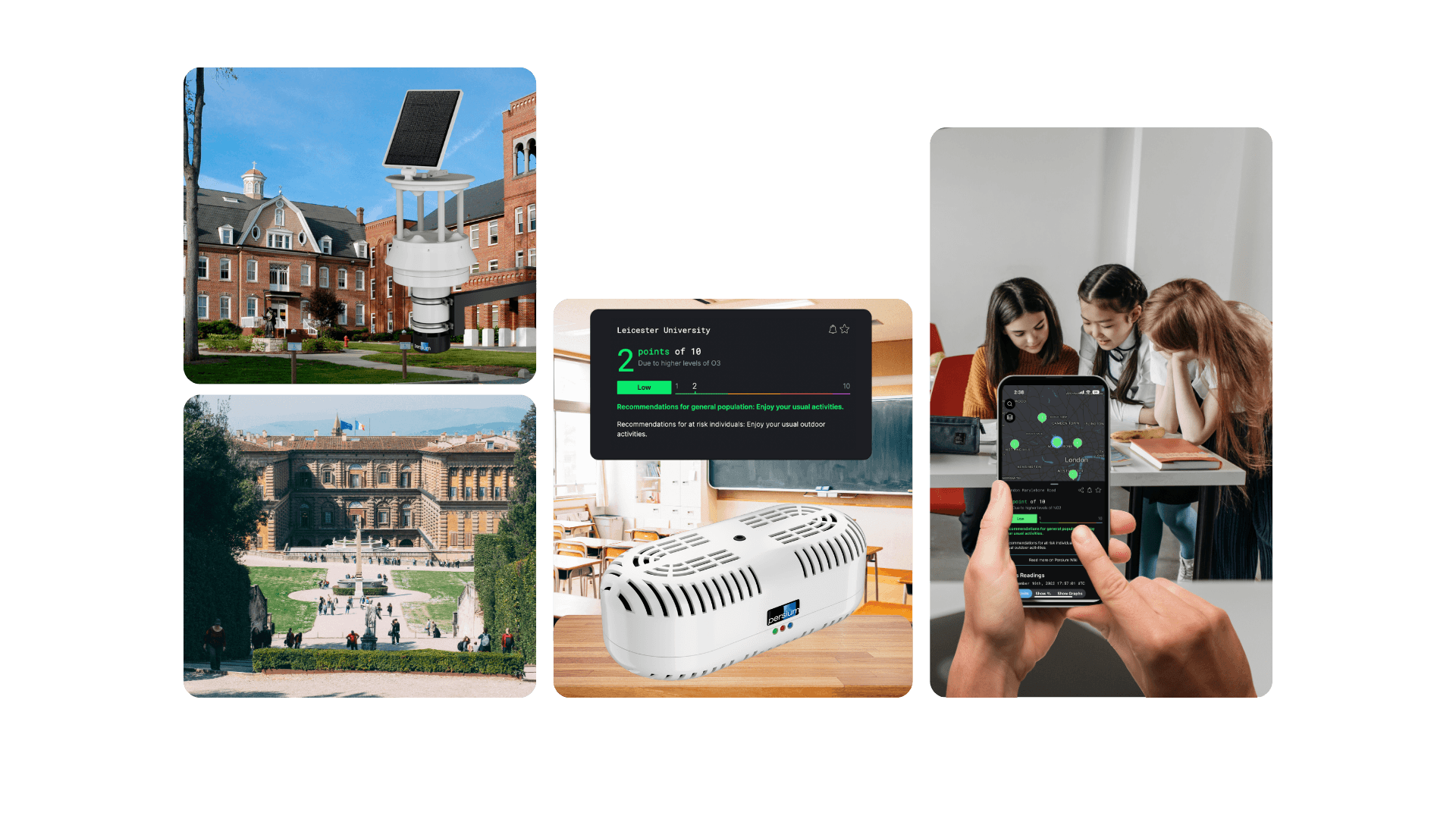
Persium works in partnership with the University of Birmingham, Imperial College London, Heriot-Watt University in the UAE, the Danish Technological Institute, and the University of Nicosia — supporting academic research programmes, indoor air quality studies, and environmental monitoring across university campuses and research facilities. In Dubai, Persium indoor sensors are also deployed across urban buildings, providing continuous real-time visibility into PM, VOCs, CO₂, temperature, and humidity across occupied spaces.
Persium works in partnership with the University of Birmingham, Imperial College London, Heriot-Watt University in the UAE, the Danish Technological Institute, and the University of Nicosia, supporting academic research programmes, indoor air quality studies, and environmental monitoring across university campuses and research facilities. In Dubai, Persium indoor sensors are also deployed across urban buildings, providing continuous real-time visibility into PM, VOCs, CO₂, temperature, and humidity across occupied spaces.
DEPLOYED IN THE FIELD
Trusted by leading universities and research institutions across Europe, the UK, and the UAE.
Trusted by leading universities and research institutions across Europe, the UK, and the UAE.





Classroom CO₂ and ventilation monitoring
Continuous CO₂ monitoring across classrooms identifies when ventilation is inadequate, enabling facilities teams to intervene before cognitive performance is affected. Real-time visibility replaces guesswork about whether windows and HVAC systems are keeping pace with occupancy.
PM2.5 and outdoor pollution ingress
Traffic-related PM2.5 from school streets and surrounding roads enters buildings through windows, doors, and ventilation systems. Persium monitors indoor PM2.5 levels continuously, identifying when and where outdoor pollution is driving indoor exposure.
TVOC monitoring
Art rooms, science laboratories, and newly refurbished spaces generate VOC emissions from solvents, cleaning products, adhesives, and building materials. Continuous TVOC monitoring identifies elevated concentrations before they affect occupant health.
Noise monitoring
Classroom noise affects concentration and teacher wellbeing. Persium Pods monitor sound levels alongside air quality, providing a unified picture of the environmental conditions affecting learning.
Research and academic programmes
Universities running environmental health, public health, or climate science programmes can use Persium Pill data as part of active research, high-precision, continuously updated indoor air quality datasets for academic study.
LEED v5 indoor air quality credits
For universities and school estates pursuing LEED v5 certification, the Persium Pill supports the continuous monitoring pathway, providing the time-stamped IAQ performance data that LEED O+M credits require. Up to 10–12 points available under the IAQ Performance credit.
Transparency and parental confidence
Real-time air quality data, shared via MapView or public dashboards, demonstrates to parents, governors, inspectors, and regulators that the school is actively managing the environment children learn in.
Classroom CO₂ and ventilation monitoring
Continuous CO₂ monitoring across classrooms identifies when ventilation is inadequate, enabling facilities teams to intervene before cognitive performance is affected. Real-time visibility replaces guesswork about whether windows and HVAC systems are keeping pace with occupancy.
PM2.5 and outdoor pollution ingress
Traffic-related PM2.5 from school streets and surrounding roads enters buildings through windows, doors, and ventilation systems. Persium monitors indoor PM2.5 levels continuously, identifying when and where outdoor pollution is driving indoor exposure.
TVOC monitoring
Art rooms, science laboratories, and newly refurbished spaces generate VOC emissions from solvents, cleaning products, adhesives, and building materials. Continuous TVOC monitoring identifies elevated concentrations before they affect occupant health.
Noise monitoring
Classroom noise affects concentration and teacher wellbeing. Persium Pods monitor sound levels alongside air quality, providing a unified picture of the environmental conditions affecting learning.
Research and academic programmes
Universities running environmental health, public health, or climate science programmes can use Persium Pill data as part of active research, high-precision, continuously updated indoor air quality datasets for academic study.
LEED v5 indoor air quality credits
For universities and school estates pursuing LEED v5 certification, the Persium Pill supports the continuous monitoring pathway, providing the time-stamped IAQ performance data that LEED O+M credits require. Up to 10–12 points available under the IAQ Performance credit.
Transparency and parental confidence
Real-time air quality data, shared via MapView or public dashboards, demonstrates to parents, governors, inspectors, and regulators that the school is actively managing the environment children learn in.
Monitoring Applications
What schools and universities use Persium for.
What schools and universities use Persium for.
In the UK, the Department for Education's Building Bulletin 101 sets ventilation standards for schools, but provides no requirement for continuous monitoring to verify compliance in practice. Post-pandemic awareness of indoor air quality in educational settings has significantly increased pressure on local authorities and academy trusts to demonstrate ventilation performance.
In the USA, the EPA's Clean Air in Buildings Challenge specifically targets schools and universities. LEED v5 increasingly rewards continuous IAQ monitoring as the highest-value certification pathway. In the GCC, international schools and universities operating to British, American, or IB curricula are subject to parent and institutional expectations that align with the most stringent global IAQ standards. Across all of these contexts, the direction is the same, evidence of performance, not just intent.
In the UK, the Department for Education's Building Bulletin 101 sets ventilation standards for schools, but provides no requirement for continuous monitoring to verify compliance in practice. Post-pandemic awareness of indoor air quality in educational settings has significantly increased pressure on local authorities and academy trusts to demonstrate ventilation performance.
In the USA, the EPA's Clean Air in Buildings Challenge specifically targets schools and universities. LEED v5 increasingly rewards continuous IAQ monitoring as the highest-value certification pathway. In the GCC, international schools and universities operating to British, American, or IB curricula are subject to parent and institutional expectations that align with the most stringent global IAQ standards. Across all of these contexts, the direction is the same, evidence of performance, not just intent.
REGULATORY CONTEXT
Indoor air quality in schools is coming under increasing regulatory scrutiny across the UK and globally.
Indoor air quality in schools is coming under increasing regulatory scrutiny across the UK and globally.
Managing indoor air quality across a school, college, or university estate?
Managing indoor air quality across a school, college, or university estate?