Use Case
Wildfire Warning System
Wildfire Warning System
Wildfire smoke carries PM2.5, CO, VOCs, and combustion gases that affect communities far beyond the fire perimeter, often before the fire itself is visible or reported. Yet most air quality monitoring networks rely on reference stations spaced kilometres apart that update hourly at best. By the time a reading reflects dangerous conditions, the event has already moved on. Without dense, continuous sensing across at-risk landscapes and downwind communities, emergency responders and public health teams are left reacting rather than anticipating.
THE CHALLENGE
Wildfires spread rapidly and generate toxic smoke that travels hundreds of miles. Standard monitoring networks are too sparse and too slow.
Persium deploys solar-powered sensor networks across wildfire-prone areas, forest edges, community boundaries, and downwind positions, continuously monitoring the combustion gases, particulates, and atmospheric conditions associated with early fire activity and smoke dispersal. When readings cross configurable thresholds, automated alerts notify emergency response teams immediately. All data streams live into MapView, giving authorities a real-time, geospatial picture of where smoke is building, how it is moving, and which communities are most at risk, without requiring power infrastructure or network connectivity at the deployment location.
WHAT PERSIUM DOES
Dense, continuous sensing across at-risk landscapes, from early detection to post-fire recovery.
Wildfire smoke carries PM2.5, CO, VOCs, and combustion gases that affect communities far beyond the fire perimeter, often before the fire itself is visible or reported. Yet most air quality monitoring networks rely on reference stations spaced kilometres apart that update hourly at best. By the time a reading reflects dangerous conditions, the event has already moved on. Without dense, continuous sensing across at-risk landscapes and downwind communities, emergency responders and public health teams are left reacting rather than anticipating.
THE CHALLENGE
Wildfires spread rapidly and generate toxic smoke that travels hundreds of miles. Standard monitoring networks are too sparse and too slow.
Persium deploys solar-powered sensor networks across wildfire-prone areas, forest edges, community boundaries, and downwind positions, continuously monitoring the combustion gases, particulates, and atmospheric conditions associated with early fire activity and smoke dispersal. When readings cross configurable thresholds, automated alerts notify emergency response teams immediately. All data streams live into MapView, giving authorities a real-time, geospatial picture of where smoke is building, how it is moving, and which communities are most at risk, without requiring power infrastructure or network connectivity at the deployment location.
WHAT PERSIUM DOES
Dense, continuous sensing across at-risk landscapes, from early detection to post-fire recovery.
Early ignition detection
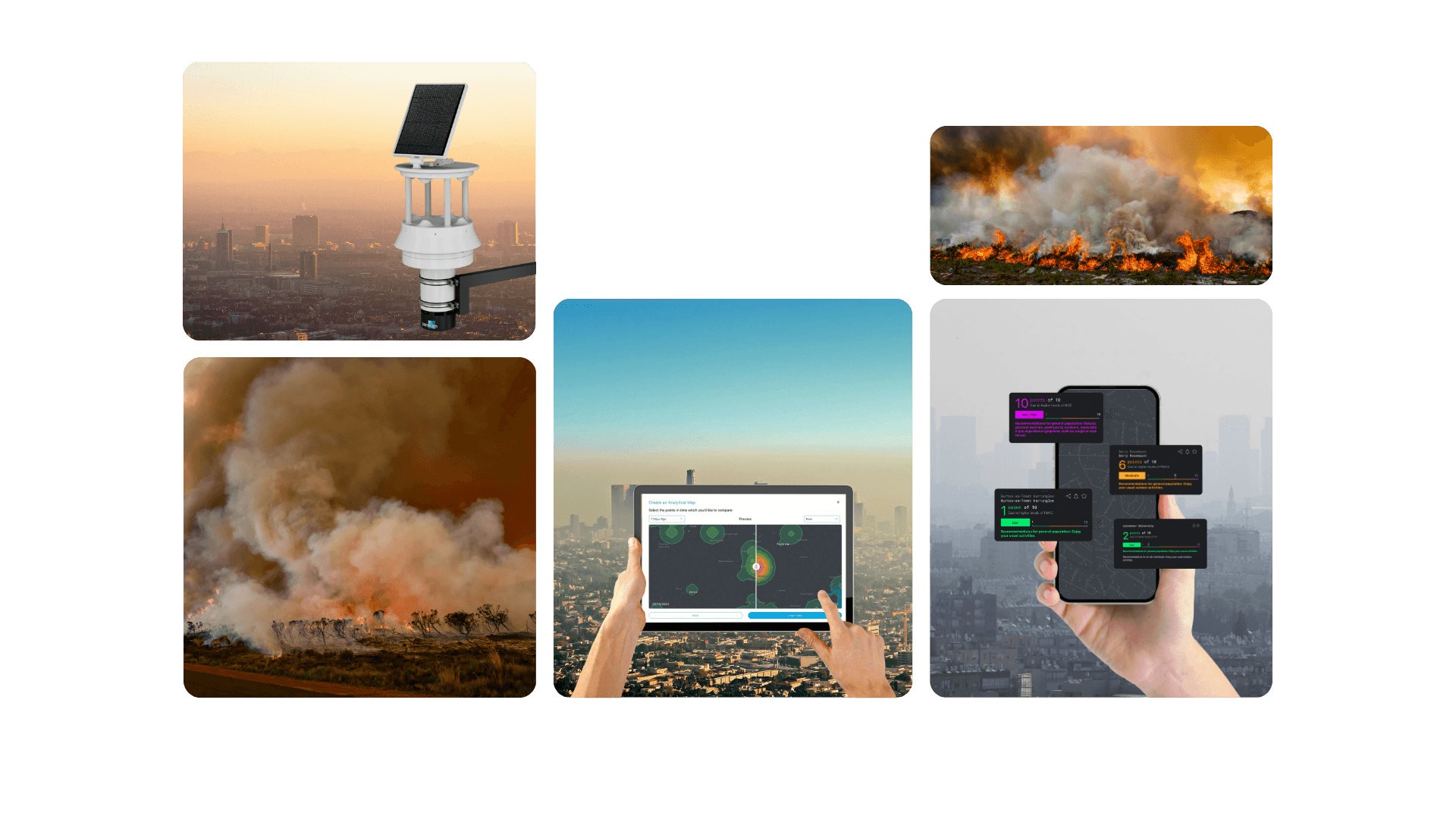
Continuous monitoring of CO, VOCs, and particulate signatures that indicate fire activity before it becomes visible or reported. Dense sensor networks across at-risk landscapes provide the earliest possible warning at the local level.
Smoke plume tracking
Real-time, wind-aware visualisation of how wildfire smoke disperses across landscapes and into populated areas. MapView heatmaps show concentration gradients as they evolve, giving authorities a live picture of which communities are entering the risk window.
Community air quality alerts
Automated notifications when PM2.5 or CO levels approach WHO health thresholds, enabling timely public guidance, school closures, and vulnerable population warnings before conditions deteriorate further.
Emergency response support
Live environmental data helps incident commanders understand ground-level conditions across a wide area, informing evacuation decisions, resource deployment, and operational safety for firefighting personnel.
Post-fire air quality monitoring
Continued monitoring after containment tracks lingering smoke, ash particulates, and toxic combustion residues, supporting community re-entry decisions and long-term air quality recovery assessment.
Baseline and risk mapping
Pre-season deployment across high-risk zones establishes baseline environmental conditions, enabling faster, more accurate detection when conditions shift during fire weather events.
Early ignition detection
Continuous monitoring of CO, VOCs, and particulate signatures that indicate fire activity before it becomes visible or reported. Dense sensor networks across at-risk landscapes provide the earliest possible warning at the local level.
Smoke plume tracking
Real-time, wind-aware visualisation of how wildfire smoke disperses across landscapes and into populated areas. MapView heatmaps show concentration gradients as they evolve, giving authorities a live picture of which communities are entering the risk window.
Community air quality alerts
Automated notifications when PM2.5 or CO levels approach WHO health thresholds, enabling timely public guidance, school closures, and vulnerable population warnings before conditions deteriorate further.
Emergency response support
Live environmental data helps incident commanders understand ground-level conditions across a wide area, informing evacuation decisions, resource deployment, and operational safety for firefighting personnel.
Post-fire air quality monitoring
Continued monitoring after containment tracks lingering smoke, ash particulates, and toxic combustion residues, supporting community re-entry decisions and long-term air quality recovery assessment.
Baseline and risk mapping
Pre-season deployment across high-risk zones establishes baseline environmental conditions, enabling faster, more accurate detection when conditions shift during fire weather events.
Monitoring Applications
What organisations use Persium for during wildfire events.
What organisations use Persium for during wildfire events.
Wildfires caused more than 30,000 excess deaths in Europe in 2022 alone. Greece, Spain, Portugal, and Turkey are investing in expanded environmental monitoring infrastructure as part of national climate adaptation strategies. In the United States, the EPA's AB 617 community air monitoring programme includes wildfire smoke as a priority exposure pathway.
Across the GCC, dust storms and extreme heat events create analogous monitoring requirements for public health authorities and emergency management agencies. In all of these contexts, the direction is the same: reactive response is insufficient. Continuous, pre-positioned monitoring is the standard that protects communities and supports defensible public health decisions.
Wildfires caused more than 30,000 excess deaths in Europe in 2022 alone. Greece, Spain, Portugal, and Turkey are investing in expanded environmental monitoring infrastructure as part of national climate adaptation strategies. In the United States, the EPA's AB 617 community air monitoring programme includes wildfire smoke as a priority exposure pathway.
Across the GCC, dust storms and extreme heat events create analogous monitoring requirements for public health authorities and emergency management agencies. In all of these contexts, the direction is the same: reactive response is insufficient. Continuous, pre-positioned monitoring is the standard that protects communities and supports defensible public health decisions.
REGULATORY CONTEXT
Wildfire air quality monitoring is becoming a public health and regulatory priority globally.
Wildfire air quality monitoring is becoming a public health and regulatory priority globally.
Wildfires and extreme environmental events don't wait for infrastructure to be installed. Persium Pods are solar-powered with integrated cellular connectivity, deployable across remote landscapes, forest edges, and community boundaries without fixed power or network infrastructure.
Sensors operate continuously from day one of deployment, transmitting live data to Persium MapView regardless of location. When conditions demand a rapid response, Persium is ready to deploy.
Wildfires and extreme environmental events don't wait for infrastructure to be installed. Persium Pods are solar-powered with integrated cellular connectivity, deployable across remote landscapes, forest edges, and community boundaries without fixed power or network infrastructure.
Sensors operate continuously from day one of deployment, transmitting live data to Persium MapView regardless of location. When conditions demand a rapid response, Persium is ready to deploy.
DEPLOY WITH PERSIUM
Solar-powered and cellular-connected, deployable anywhere, from day one.
Solar-powered and cellular-connected, deployable anywhere, from day one.
Protecting communities from wildfire smoke and extreme environmental events?
Protecting communities from wildfire smoke and extreme environmental events?