
Use Case
Mining and Quarrying
Mining and Quarrying
Extraction, haulage, blasting, and stockpile activity create dust and pollutant events that change minute by minute with activity levels, weather, and wind. Periodic spot checks and boundary visits capture a moment in time, not the conditions that drive worker exposure, community impact, or permit exceedances. Without continuous, real-time data across operational zones and site perimeters, operators have no early warning system, no defensible compliance record, and no way to verify whether dust suppression measures are actually working.
THE CHALLENGE
Mining and quarrying operations generate dust and emissions that shift rapidly, and periodic monitoring can't keep pace.
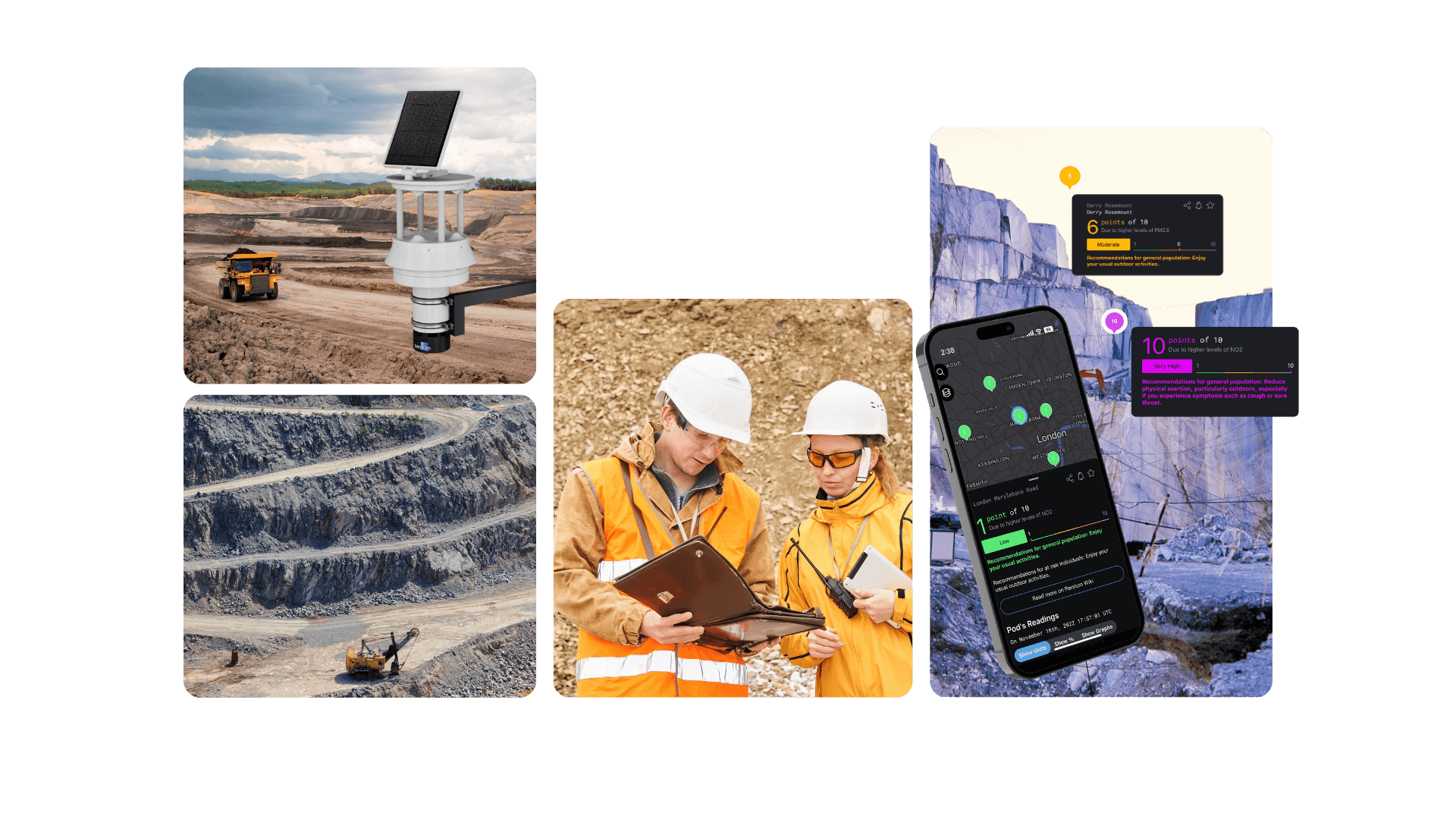
Persium deploys sensor networks across active operational areas, access roads, haul routes, stockpile zones, and site perimeters, delivering real-time data on particulate matter, gases, noise, wind, and atmospheric conditions throughout the working day. Wind data from every sensor links concentration spikes to their likely source. Configurable threshold alerts notify operational and HSE teams before conditions become unsafe or non-compliant. All data is time-stamped, exportable, and audit-ready from day one.
WHAT PERSIUM DOES
Continuous, site-wide environmental monitoring, from extraction zones to community boundaries.
Extraction, haulage, blasting, and stockpile activity create dust and pollutant events that change minute by minute with activity levels, weather, and wind. Periodic spot checks and boundary visits capture a moment in time, not the conditions that drive worker exposure, community impact, or permit exceedances. Without continuous, real-time data across operational zones and site perimeters, operators have no early warning system, no defensible compliance record, and no way to verify whether dust suppression measures are actually working.
THE CHALLENGE
Mining and quarrying operations generate dust and emissions that shift rapidly, and periodic monitoring can't keep pace.
Persium deploys sensor networks across active operational areas, access roads, haul routes, stockpile zones, and site perimeters, delivering real-time data on particulate matter, gases, noise, wind, and atmospheric conditions throughout the working day. Wind data from every sensor links concentration spikes to their likely source. Configurable threshold alerts notify operational and HSE teams before conditions become unsafe or non-compliant. All data is time-stamped, exportable, and audit-ready from day one.
WHAT PERSIUM DOES
Continuous, site-wide environmental monitoring, from extraction zones to community boundaries.
Worker dust exposure monitoring
Continuous PM1, PM2.5, PM10, and coarser dust fraction monitoring across active extraction zones, tracking exposure levels in real time and triggering alerts when concentrations approach occupational health limits. Evidence that protects both workers and the organisations responsible for them.
Dust suppression verification
Measure whether water sprays, dust suppressants, and haul road treatments are actually delivering reductions, in real time, not after a quarterly report. Adjust operations based on live data rather than scheduled assumptions.
Boundary and community impact monitoring
Perimeter sensors capture how dust and noise travel beyond the site boundary into surrounding residential areas, farms, and sensitive receptors. Real-time visibility enables proactive response before a complaint becomes an enforcement notice or a permit condition breach.
Source apportionment
Every Persium Pod includes a built-in 3D wind sensor. Correlating PM and gas spikes with wind direction and speed identifies which operations, haul routes, or stockpiles are driving emission events, enabling targeted interventions rather than site-wide shutdowns.
Noise monitoring
Mining and quarrying noise is subject to tightening regulation near residential areas. Persium Pods monitor sound levels continuously alongside dust and air quality, delivering a unified environmental dataset from a single deployed sensor.
Regulatory and ESG reporting
Generate auditable, continuous records that satisfy environmental permit conditions, local authority requirements, and ESG disclosure frameworks. Time-stamped data that demonstrates compliance, and demonstrates it proactively, not in response to an incident.
Worker dust exposure monitoring
Continuous PM1, PM2.5, PM10, and coarser dust fraction monitoring across active extraction zones, tracking exposure levels in real time and triggering alerts when concentrations approach occupational health limits. Evidence that protects both workers and the organisations responsible for them.
Dust suppression verification
Measure whether water sprays, dust suppressants, and haul road treatments are actually delivering reductions, in real time, not after a quarterly report. Adjust operations based on live data rather than scheduled assumptions.
Boundary and community impact monitoring
Perimeter sensors capture how dust and noise travel beyond the site boundary into surrounding residential areas, farms, and sensitive receptors. Real-time visibility enables proactive response before a complaint becomes an enforcement notice or a permit condition breach.
Source apportionment
Every Persium Pod includes a built-in 3D wind sensor. Correlating PM and gas spikes with wind direction and speed identifies which operations, haul routes, or stockpiles are driving emission events, enabling targeted interventions rather than site-wide shutdowns.
Noise monitoring
Mining and quarrying noise is subject to tightening regulation near residential areas. Persium Pods monitor sound levels continuously alongside dust and air quality, delivering a unified environmental dataset from a single deployed sensor.
Regulatory and ESG reporting
Generate auditable, continuous records that satisfy environmental permit conditions, local authority requirements, and ESG disclosure frameworks. Time-stamped data that demonstrates compliance, and demonstrates it proactively, not in response to an incident.
Monitoring Applications
What mining and quarrying operators use Persium for.
What mining and quarrying operators use Persium for.

In the UK, planning conditions for quarrying operations near sensitive receptors routinely require continuous dust monitoring under the Minerals Planning Guidance and local authority environmental health frameworks. Across Europe, the revised Industrial Emissions Directive is expanding continuous monitoring requirements for extractive industry operations. In the GCC, national environmental compliance frameworks under NCEC and regional equivalents are tightening permit conditions for mining, aggregate, and phosphate extraction operations.
ESG disclosure requirements, particularly for listed mining companies, are driving additional pressure for verifiable, continuous environmental data across operational sites. Periodic sampling is no longer sufficient. Persium provides continuous monitoring that generates the evidence base regulators, investors, and communities increasingly expect.
In the UK, planning conditions for quarrying operations near sensitive receptors routinely require continuous dust monitoring under the Minerals Planning Guidance and local authority environmental health frameworks. Across Europe, the revised Industrial Emissions Directive is expanding continuous monitoring requirements for extractive industry operations. In the GCC, national environmental compliance frameworks under NCEC and regional equivalents are tightening permit conditions for mining, aggregate, and phosphate extraction operations.
ESG disclosure requirements, particularly for listed mining companies, are driving additional pressure for verifiable, continuous environmental data across operational sites. Periodic sampling is no longer sufficient. Persium provides continuous monitoring that generates the evidence base regulators, investors, and communities increasingly expect.
REGULATORY CONTEXT
Environmental permit conditions for mining and quarrying are increasingly requiring continuous monitoring.
Environmental permit conditions for mining and quarrying are increasingly requiring continuous monitoring.
Mining and quarrying sites often lack fixed power and reliable network infrastructure across operational areas. Persium Pods are solar-powered and cellular-connected, deployable across any location on site from day one, without infrastructure investment. Engineered to operate at temperatures up to +85°C and withstand demanding outdoor conditions. One platform manages sensors across the entire site, from active extraction faces to perimeter boundaries and community monitoring points.
Mining and quarrying sites often lack fixed power and reliable network infrastructure across operational areas. Persium Pods are solar-powered and cellular-connected, deployable across any location on site from day one, without infrastructure investment. Engineered to operate at temperatures up to +85°C and withstand demanding outdoor conditions. One platform manages sensors across the entire site, from active extraction faces to perimeter boundaries and community monitoring points.
DEPLOY WITH PERSIUM
Solar-powered, cellular-connected monitoring across any mining environment.
Solar-powered, cellular-connected monitoring across any mining environment.
Managing dust, noise, and environmental compliance across a mining or quarrying operation?
Managing dust, noise, and environmental compliance across a mining or quarrying operation?