Introduction: The Shift to Hyper-Local
For decades, cities have relied on a small number of “official” air quality monitoring stations to understand pollution. These stations are often placed at airports, rooftops, or urban background locations to represent city-wide averages. While useful for long-term trends, they no longer reflect how people actually experience air quality on the ground.
A single monitoring station cannot tell you what children are breathing outside a school, how pollution behaves on a congested street canyon, or how emissions accumulate near industrial boundaries. Exposure is local, uneven, and shaped by urban form, traffic behaviour, and weather conditions.
This is where the concept of the Breathable City emerges.
A breathable city is not defined by an annual average or a single index. It is a city that uses granular, hyper-local data to understand exposure at street, neighbourhood, and building level, and uses that insight to make targeted, evidence-led interventions that improve health where it matters most.
Cities that succeed in improving air quality are those that move beyond “monitoring for reporting” and toward monitoring for decision-making.
Step 1: The Baseline - The "Discovery" Phase
The goal: Establish a 30–60 day diagnostic period that reveals how air quality really behaves.
Before a city can fix air quality problems, it must first see them clearly. The discovery phase focuses on building a temporary or semi-permanent dense monitoring grid to capture high-resolution data across different neighbourhoods.
Using low-cost, high-precision sensors deployed at street level, cities can observe:
Daily and weekly pollution patterns
Peak exposure times
The influence of traffic, weather, and human activity
Key action: Identify data gaps.
This phase is especially powerful when cities compare their existing macro-level data (from background stations or satellites) with newly collected micro-level data. The contrast often reveals pollution hotspots and exposure patterns that were previously invisible.
The discovery phase establishes the baseline against which all future interventions will be measured.
Step 2: Hotspot Identification and Mapping the Risk
The goal: Pinpoint where pollution is concentrated and why.
Once baseline data is collected, it should be overlaid with city layers such as:
Schools and childcare facilities
Hospitals and care homes
Transit corridors and logistics routes
Industrial and construction boundaries
This spatial analysis transforms raw data into insight.
It is often at this stage that cities observe well-known but poorly quantified phenomena, such as:
Street canyon effects, where pollution becomes trapped between buildings
Emissions spikes linked to heavy-duty idling near logistics centres
Boundary effects where industrial activity impacts nearby residential areas
Technical insight: Analysing the relationship between PM₂.₅ and NOₓ helps distinguish between traffic-related pollution and emissions from nearby industrial or commercial sources.
Hotspot mapping allows cities to move from “where is pollution high?” to “what is causing it here?”
Step 3: Policy Design and Air Quality Planning
The goal: Turn data into targeted, measurable action.
Data should not sit passively on a dashboard. In a breathable city, monitoring directly informs policy design and operational change.
Examples of evidence-led interventions include:
School Streets: Temporarily restricting traffic during drop-off and pick-up hours where monitoring shows repeated exposure spikes.
Green Buffers: Deploying vegetation strategically in identified hot zones to reduce particulate exposure and improve microclimates.
Traffic Re-routing: Using real-time data to divert heavy vehicles during periods of atmospheric stagnation or poor dispersion.
Because these actions are grounded in measured exposure, they are easier to justify politically and more likely to deliver measurable results.
Step 4: Public Engagement - Building trust Through Transparency
The goal: Bring citizens into the process.
Air pollution is often described as a “silent” issue. People know it exists, but they cannot see it. Visualisation changes that.
Cities that share air quality data openly, through public dashboards, maps, or mobile applications, create transparency and trust. When residents can see:
Where air quality is improving
When interventions are working
How exposure varies across neighbourhoods
they are more likely to support policy changes, including low-emission zones, traffic restrictions, or green infrastructure investment.
This is the principle of democratic data: making health-relevant information accessible, understandable, and shared.
Step 5: The Audit - Measuring the ROI of Clean Air
The goal: prove impact and secure future investment.
The final step is closing the loop. A hyper-local network enables cities to produce before-and-after analyses that quantify the real-world impact of interventions.
Key metrics often include:
Health outcomes: Changes in respiratory-related hospital admissions in targeted areas
Economic indicators: Shifts in retail footfall, property values, or street-level activity in cleaner zones
Compliance: Progress toward meeting WHO, EU, or national air quality directives
This audit phase turns air quality management into a continuous improvement cycle, rather than a one-off project.
How Persium Supports the Breathable City Approach
Persium works with cities and public authorities to deliver the full lifecycle of hyper-local air quality monitoring, from discovery through to audit.
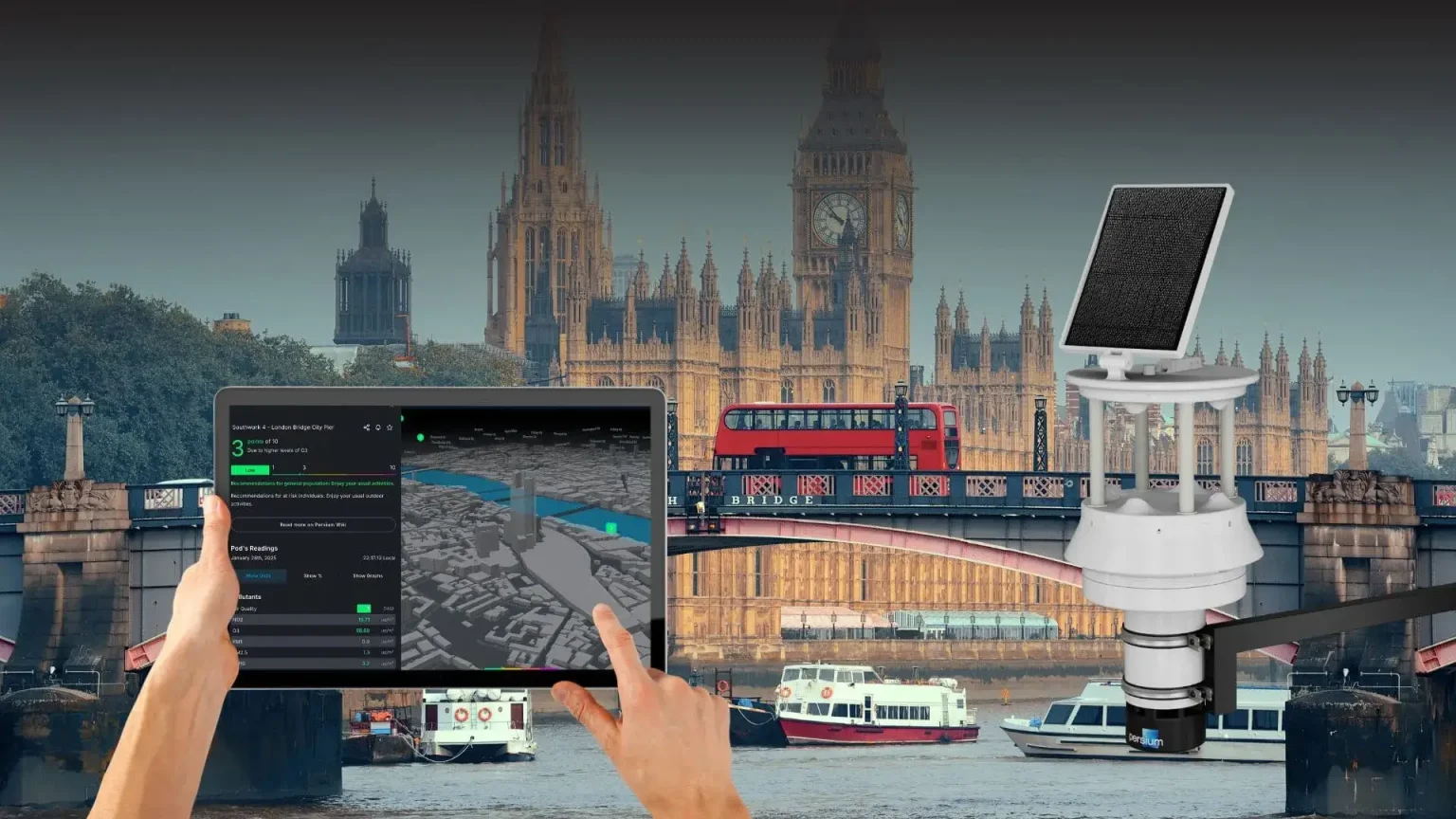
Persium Pods enable dense, street-level monitoring with high spatial resolution, capturing both pollutant concentrations and environmental context. This allows cities to move beyond sparse networks and better understand exposure where people actually live, travel, and spend time.
All data flows into Persium’s digital platform, where it can be visualised, analysed, and compared across time and location. Dashboards, heatmaps, and spatial analysis tools support hotspot identification, policy testing, and transparent public communication.
By combining advanced air quality monitoring sensors, scalable networks, and decision-ready data, Persium helps cities turn air quality monitoring into a practical tool for healthier, more breathable urban environments, rather than just another reporting obligation.