Use Case
LEED Green Building
Certification
Use Case
LEED Green Building
Certification
LEED v5 is moving away from checklists and one-off tests. It increasingly rewards how indoor environments perform once people are inside, measured continuously over time, not demonstrated once before occupancy. Under LEED v5 O+M, up to 10–12 points are tied to Indoor Air Quality Performance. Not design intent. Outcomes.
LEED v5 is moving away from checklists and one-off tests. It increasingly rewards how indoor environments perform once people are inside, measured continuously over time, not demonstrated once before occupancy. Under LEED v5 O+M, up to 10–12 points are tied to Indoor Air Quality Performance. Not design intent. Outcomes.
THE CHALLENGE
LEED v5 no longer rewards what you intend to do. It rewards what your building actually does.
LEED v5 no longer rewards what you intend to do. It rewards what your building actually does.
The Persium Pill continuously monitors the key IAQ parameters referenced by LEED — PM2.5, CO₂, TVOCs, temperature, and relative humidity, at 1-minute intervals, automatically uploaded to the Persium Cloud. Data is time-stamped, exportable, and accessible via dashboard or API, creating the verifiable record that project teams and LEED assessors need during certification review. Persium does not submit data to LEED or award points. We provide the monitoring infrastructure and documentation that makes your certification case.
The Persium Pill continuously monitors the key IAQ parameters referenced by LEED — PM2.5, CO₂, TVOCs, temperature, and relative humidity, at 1-minute intervals, automatically uploaded to the Persium Cloud. Data is time-stamped, exportable, and accessible via dashboard or API, creating the verifiable record that project teams and LEED assessors need during certification review. Persium does not submit data to LEED or award points. We provide the monitoring infrastructure and documentation that makes your certification case.
WHAT PERSIUM DOES
Persium turns your building's indoor air into auditable evidence.
Persium turns your building's indoor air into auditable evidence.
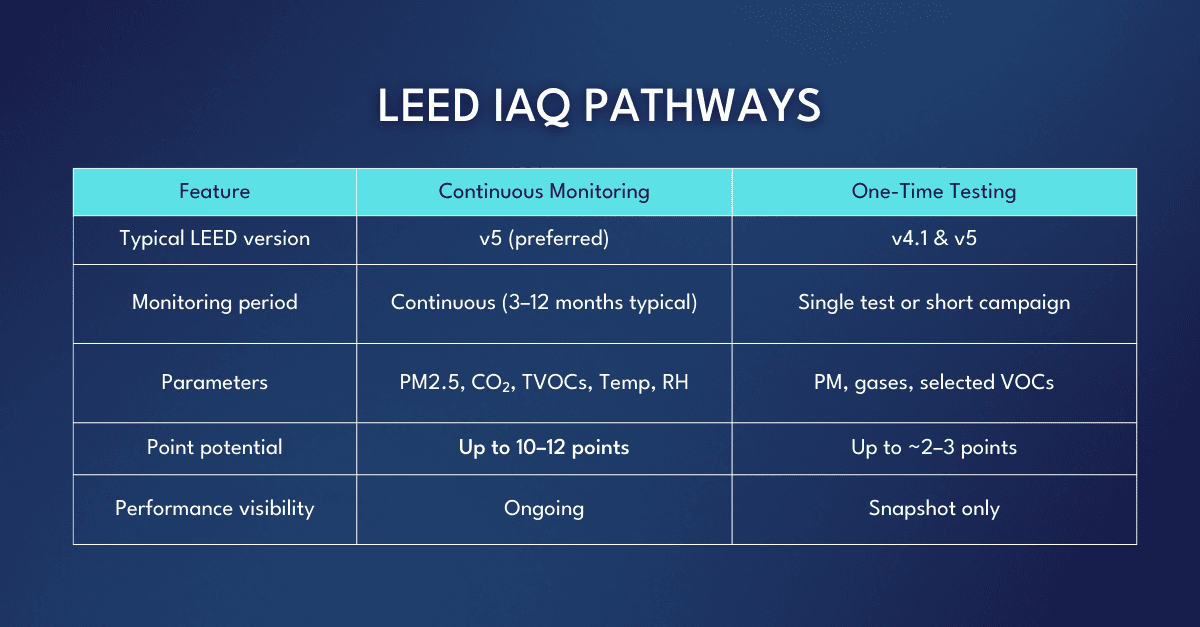
Continuous Monitoring up to 10–12 points (LEED v5 O+M)
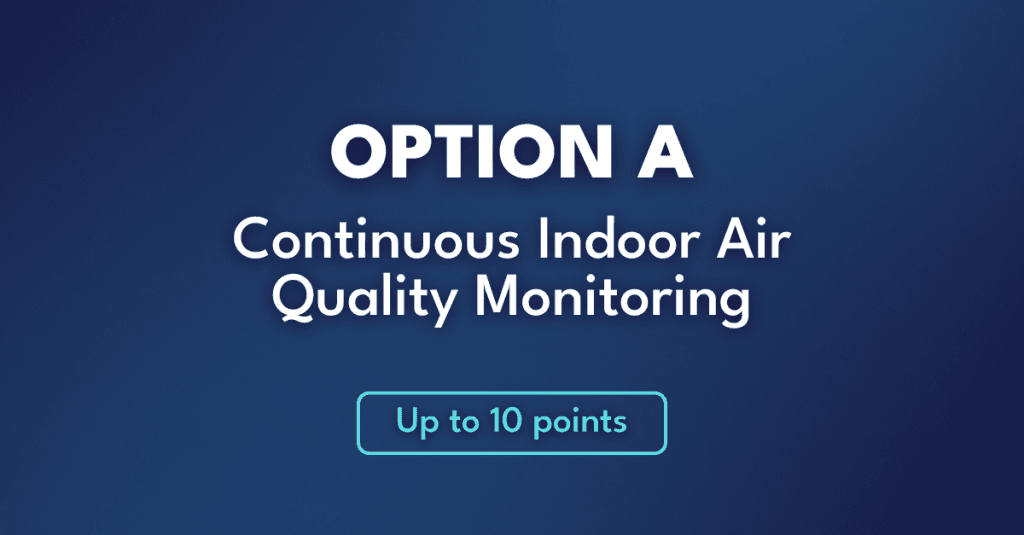
The highest-value pathway and LEED's preferred approach under v5. Buildings earn points by installing permanent IAQ sensors, continuously monitoring key parameters, and demonstrating sustained performance over time. Persium supports this pathway directly, providing the continuous, time-stamped dataset required for documentation and review.
Parameters monitored: PM2.5, CO₂, TVOCs, temperature, relative humidity.
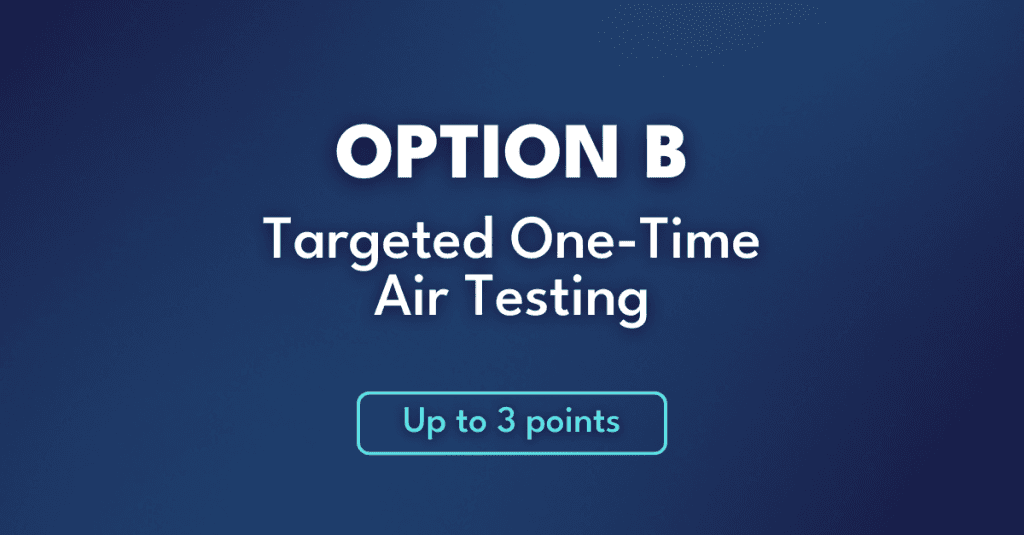
A valid but limited pathway, typically conducted before occupancy. Focuses on meeting minimum concentration limits for PM2.5, PM10, CO, NO₂, O₃, and specific VOCs such as formaldehyde. Provides a snapshot in time, but does not demonstrate ongoing indoor air quality performance. Lower point potential and increasingly deprioritised under LEED v5.
One-Time Baseline Testing
up to 2–3 points
The highest-value pathway and LEED's preferred approach under v5. Buildings earn points by installing permanent IAQ sensors, continuously monitoring key parameters, and demonstrating sustained performance over time. Persium supports this pathway directly, providing the continuous, time-stamped dataset required for documentation and review.
Parameters monitored: PM2.5, CO₂, TVOCs, temperature, relative humidity.
Continuous Monitoring
up to 10–12 points (LEED v5 O+M)
The highest-value pathway and LEED's preferred approach under v5. Buildings earn points by installing permanent IAQ sensors, continuously monitoring key parameters, and demonstrating sustained performance over time. Persium supports this pathway directly, providing the continuous, time-stamped dataset required for documentation and review.
Parameters monitored: PM2.5, CO₂, TVOCs, temperature, relative humidity.
Continuous Monitoring
up to 10–12 points
(LEED v5 O+M)
A valid but limited pathway, typically conducted before occupancy. Focuses on meeting minimum concentration limits for PM2.5, PM10, CO, NO₂, O₃, and specific VOCs such as formaldehyde. Provides a snapshot in time, but does not demonstrate ongoing indoor air quality performance. Lower point potential and increasingly deprioritised under LEED v5.
One-Time Baseline Testing
up to 2–3 points
LEED REPORTING
Everything your project team needs for certification documentation.
Time-stamped IAQ datasets
Continuous data covering the full required monitoring period, formatted for LEED documentation and assessor review.
Exportable data files
CSV downloads and API access for sustainability consultants, LEED assessors, and internal reporting teams.
Clear dashboards
Live and historical visualisation of IAQ trends, averages, and exceedances, showing how your building performs against LEED thresholds over time.
Sensor specifications
Full technical documentation to support equipment and performance requirements during certification review.
Time-stamped IAQ datasets
Continuous data covering the full required monitoring period, formatted for LEED documentation and assessor review.
Exportable data files
CSV downloads and API access for sustainability consultants, LEED assessors, and internal reporting teams.
Clear dashboards
Live and historical visualisation of IAQ trends, averages, and exceedances, showing how your building performs against LEED thresholds over time.
Sensor specifications
Full technical documentation to support equipment and performance requirements during certification review.
LEED REPORTING
Everything your project team needs for certification documentation.
CO₂ levels above 1,500 ppm are linked to a 12% drop in cognitive performance. PM2.5 exposure increases absenteeism. Poor indoor air quality costs organisations in ways that don't show up on a building audit, but do show up in productivity, retention, and occupant wellbeing.
Continuous monitoring doesn't just support LEED certification. It gives building operators the intelligence to manage indoor conditions proactively, and demonstrate to tenants, investors, and regulators that the building performs as promised.
WHY THIS MATTERS
Beyond certification. Buildings that perform.
CO₂ levels above 1,500 ppm are linked to a 12% drop in cognitive performance. PM2.5 exposure increases absenteeism. Poor indoor air quality costs organisations in ways that don't show up on a building audit, but do show up in productivity, retention, and occupant wellbeing.
Continuous monitoring doesn't just support LEED certification. It gives building operators the intelligence to manage indoor conditions proactively, and demonstrate to tenants, investors, and regulators that the building performs as promised.
WHY THIS MATTERS
Beyond certification. Buildings that perform.
In Dubai, Persium indoor sensors are deployed across commercial urban buildings, providing continuous real-time visibility into PM, VOCs, CO₂, temperature, and humidity across occupied spaces. In the London Underground, Persium monitors particulate matter and environmental conditions across subsurface passenger environments — in partnership with Transport for London and Imperial College London.
In Dubai, Persium indoor sensors are deployed across commercial urban buildings, providing continuous real-time visibility into PM, VOCs, CO₂, temperature, and humidity across occupied spaces. In the London Underground, Persium monitors particulate matter and environmental conditions across subsurface passenger environments, in partnership with Transport for London and Imperial College London.
DEPLOYMENTS
Persium is monitoring indoor air quality across real environments.
Persium is monitoring indoor air quality across real environments.


Working toward LEED certification?
Start with the right monitoring infrastructure.
Working toward LEED certification?
Start with the right monitoring infrastructure.